OfferHigh Performing Teams
Psychologist and Krav Maga instructor in one
High Performing
Teams
You don't practise collaboration at a table
5 hours
Or split across half-days
One facilitator
Psychologist and Krav Maga instructor
4 to max 20
Participants per group
From €3.950
Excl. VAT, for the whole group
Most team days are about collaboration. People talk about trust, about giving feedback, about holding each other to account. Everyone nods. Two weeks later the workplace is unchanged.
The problem is not the content. The problem is that a team that talks about trust does not practise trust. As long as you sit at a table, everyone keeps their professional mask on.
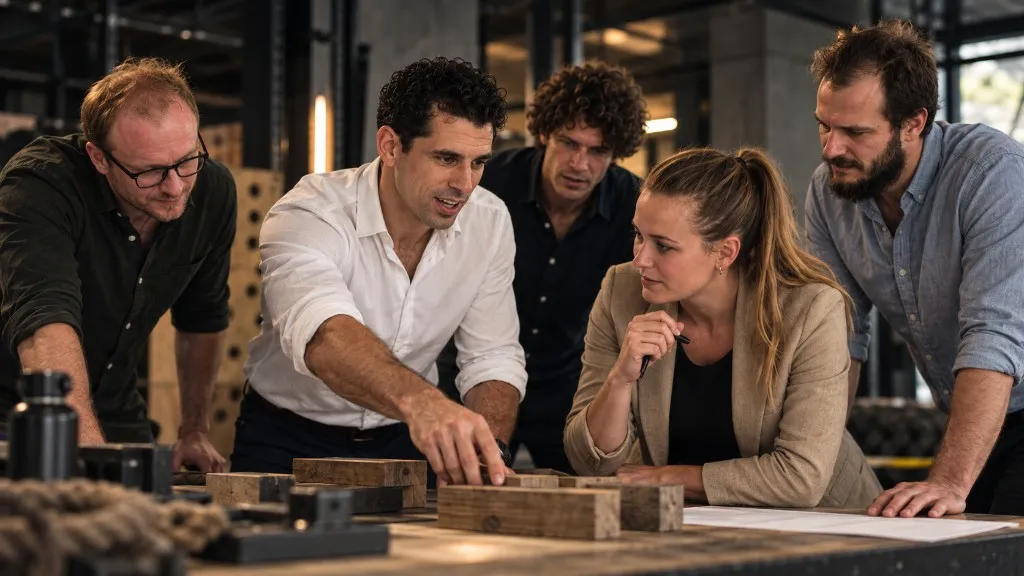
High Performing Teams lasts five hours and takes you away from that table. Your team gets physical assignments that only work if you can rely on each other, and after each exercise you talk it through with a facilitator who, as a psychologist, sees what happened in the team and, as a Krav Maga instructor, sees what happened technically.
No PowerPoint. A day after which your team knows how it deals with each other under pressure.
What a physical setting does that a meeting does not
The masks come off
In a meeting you can present yourself well, as long as you stay inside your comfort zone. During an exercise where you sweat, where something does not work at once and a colleague is holding you, that gets harder. What you see then is how people actually react when it gets uncomfortable.
Feedback is immediately clear
In Krav Maga you do not have to tell anyone that something did not work. You feel it, and so does your partner. That is the difference with most team days: you are not working on your own result, but on something that only works together. Every exercise therefore becomes a small feedback conversation with a colleague, and you have that conversation dozens of times in one day. That routine comes back to the office with you.
Boundaries become concrete
Participants train in pairs and have to tell each other what does and does not feel comfortable. Anyone who learns to say "this is too hard" later finds it easier to say "this no longer fits in my week". Setting a boundary stops being an abstract intention and becomes something you actually did that day.
Hierarchy briefly stops mattering
The manager does the same exercise as the intern, and is not automatically the one who does it best. That shifts something in a team that a talking session rarely achieves.
What about the Lego?
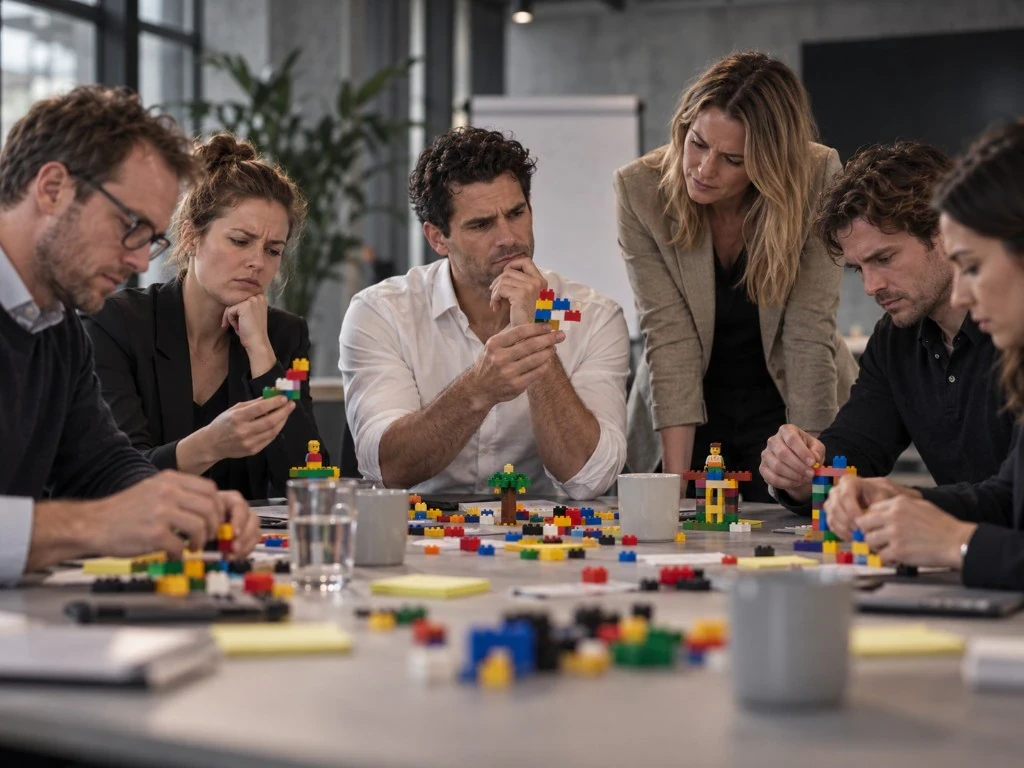
Where Lego is typically used, a team session looks like this. Everyone makes a model of "my unique strength in this team" and explains it for two minutes. Or one person is blindfolded and has to copy a structure on a colleague's instructions. Or everyone gets the same six bricks and two minutes to build a duck, after which it turns out — hold on — that everyone has made a different duck.
Those exercises work. Seriously. Quieter team members get a voice, the blindfold task shows painfully well how vague most instructions are, and the duck makes a decent point about differences in interpretation in two minutes.
There is a ceiling, though. At the building table you remain the colleague you are at the office. Your heart rate never goes above ninety, nobody has to hold you, and if it does not work you can make a joke and keep building. The masks stay on — they are just made of plastic for a while.
We have nothing against Lego. But experience has taught us that a team that wants to discover how it works together under pressure also needs a little pressure.
What research says about high performing teams
Ron Friedman researched for Harvard Business Review what teams that demonstrably perform better do differently from average teams. Five things came out. All five are about behaviour, not talent.
They call each other more often
High performing teams communicate more directly and pick up the phone sooner instead of emailing. That prevents misunderstandings and keeps the relationship warm.
They handle meetings more strategically
More preparation beforehand, more often an agenda, and more often a short check-in in which everyone gets a turn to speak.
They also talk about non-work
Personal interests, coffee, a drink after work. That looks like wasted time, but it builds the bond you fall back on when things get tense.
They express appreciation more often
Both from colleagues to each other and from managers. That creates a culture in which people feel seen and dare more.
They are more authentic
There is room for the full range of emotions, including the less flattering ones. Anyone who no longer has to hide irritation or uncertainty keeps headspace for the work itself.
What stands out: none of these five points is a skill you learn in a presentation. They are all habits that form when people know each other well enough not to have to keep up appearances. That is exactly what a physical day accelerates.
That well-structured team building works is also backed more broadly. In a meta-analysis of twenty studies, Klein and colleagues found that team building has its strongest effect on trust, cohesion and communication, and pays off most when the team sets its own goals and roles are clarified. That is exactly what happens in Part 1 and in the debrief.
Sources: Ron Friedman, Harvard Business Review (2021); Klein et al., Does Team Building Work?, Small Group Research (2009).
What a day looks like
Part 1 · ± 45 min
Arrival and frame
A short conversation about where the team is now. What is going well, where it gets stuck, what the client actually wants to see change. The psychologist asks the questions that sharpen the rest of the day.
Part 2 · ± 75 min
Physical foundation
Krav Maga basics: stance, distance, breaking a grab, striking a pad. Everyone starts moving and the ice breaks. No experience needed.
Part 3 · ± 90 min
Collaborating under pressure
Assignments in pairs and small groups in which one person has to protect a colleague, and scenarios with time pressure. A short debrief after every assignment. This is where it becomes visible who takes the lead, who waits, who communicates and who goes quiet.
Part 4 · ± 60 min
Debrief
The most important part: this is where the short debriefs of the day come together. The psychologist feeds back what happened in the team and links it to how you deal with each other at work. The team itself makes a few concrete agreements.
Close · ± 30 min
Certificate and summary
A certificate, a group photo, and a short summary the client takes away. It contains the team's agreements, never observations about individual participants.
Prefer it spread across several half-days or as a trajectory over a longer period? That is possible. We discuss the setup beforehand.
What you take away
A shared experience and a shared language
Back at the office you can refer to what happened that day. That works faster than a model from a training.
Sight of the patterns in your team
Who takes the lead, who goes quiet under pressure, where communication stalls. Five hours of physical collaboration makes that visible.
Concrete agreements
Not an action list of fourteen points, but a few things the team itself has formulated and wants to stick to.
A lower barrier to approaching each other
Anyone who has sweated and laughed together later finds it easier to ask a question or give feedback sooner.
Honestly: one day does not automatically change a team culture. What a day like this does do is give a team concrete reference points for discussing and improving everyday collaboration. Want to keep the agreements alive? Book the optional online check-in after six to eight weeks.
Practical
- Duration
- 5 hours, or split across several half-days.
- Facilitation
- An experienced psychologist who is also a certified Krav Maga instructor.
- Group size
- From 4 up to a maximum of 20 participants.
- Location
- At your location. A flat space of about two square metres per participant. No suitable space? Then we arrange one.
- Clothing
- Sportswear. You need nothing else, we bring the equipment.
- Experience
- Not needed. Every exercise has a lighter variant.
- Price
- From €3.950 excl. VAT for the whole group, excluding venue hire and travel.
- Included
- Intake beforehand, a tailored programme, a certificate per participant, a group photo.
- Confidentiality
- The client receives the team's agreements, never observations about individual participants.
- Optional: follow-up
- Online check-in with the team after six to eight weeks. What has come of the agreements and what needs adjusting? €250 excl. VAT.
Who this is and is not for
Yes, if you
- have a team that collaborates well on paper but needs more connection in practice
- need to become a team again after a reorganisation, a merger or a lot of new people
- want more than an activity with drinks afterwards
- are willing to really talk through what happened afterwards
No, if you
- are mainly looking for a fun outing — choose the Introduction to Krav Maga of 70 minutes instead
- have an acute conflict or an individual problem — that needs a different intervention, and we will advise you honestly about that in the intake
- want to make participation compulsory for people who do not want to take part
These teams went first
Een super leerzame workshop en een geweldige teambuilding. Je komt als collega's letterlijk en figuurlijk op een andere manier met elkaar in aanraking.
It was a fantastic team building experience which we all talked about for many days after. We learnt some self-defense moves, we bonded as a team, laughed, and 'suffered' as a team.
You can read more experiences in the reviews.











Discuss the setup
Tell us briefly where your team is and what you want to achieve. We think along with no obligation and then send a proposal designed for you.
Why teams choose us
- More than 4397+ students trained
- For 10+ large companies in the Netherlands
- Rating · 5.0 (89 reviews) on Facebook
- Always through our Monkees learning method
Our team is ready for you



Need help or advice?
Want to talk through your learning need? Get in touch — I am happy to think along. No obligation and free of charge.
Ivo Oostwegel
- General
- info@defensemonkees.nl
- Venues
- Amsterdam · Utrecht · Maastricht · Heerlen